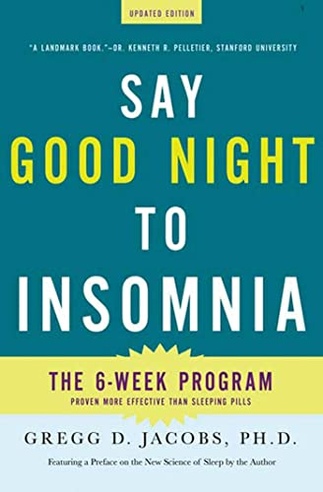
What the Book Covers
"Say Good Night to Insomnia" is a practical manual for tackling one of modern life's most frustrating problems: the inability to sleep well. Dr. Gregg D. Jacobs walks you through a six-week program rooted in Cognitive Behavioral Therapy for Insomnia (CBT-I), a technique developed and tested at Harvard Medical School over nearly two decades.
The program isn't mysterious or complicated. It centers on retraining your brain and body to associate bed with actual sleep, not with anxiety or wakefulness. Jacobs covers sleep restriction (deliberately limiting time in bed initially), stimulus control (using your bedroom only for sleep), and cognitive techniques to challenge anxious thoughts about sleep. You'll also explore sleep-promoting lifestyle habits: exercise timing, caffeine and alcohol, relaxation practices, and learn how worry cycles feed insomnia.
The book includes worksheets and sleep logs to track patterns, helping you understand your personal sleep architecture. What makes this different from generic sleep advice is the scientific backbone: Jacobs doesn't just tell you what to do; he explains why it works, drawing on decades of research.
Who Should Read This
If you've wrestled with insomnia and are tired of relying on pills, this book is worth your time. It's designed for people with mild-to-moderate sleep issues: those who take an hour to fall asleep, wake frequently, or lie awake worrying. The research shows about 75% of participants become normal sleepers after completing the program.
However, if you have severe insomnia, complex medical conditions affecting sleep, or sleep apnea, this book may feel insufficient on its own. It's also not a quick fix for shift workers or people whose insomnia stems from major depression or bipolar disorder, though it could be a helpful complement to professional treatment.
The audiobook version, narrated clearly, works well if you prefer listening. The Kindle or paperback formats are equally useful for working through the exercises.
Strengths and Weaknesses
What Works Well
The Harvard credentials matter. This isn't self-help fluff: it's a program that has been rigorously tested in clinical settings. Jacobs is transparent about the outcomes: 100% report improved sleep, and 75% achieve normal sleep. He doesn't oversell or make wild promises.
The structure is genuinely helpful. Organizing the program into six clear weeks, with specific techniques for each week, removes decision fatigue. You know exactly what to work on and when. The sleep logs and worksheets are practical tools, not filler.
The cognitive work is particularly valuable. Many insomniacs develop a fear of bedtime itself: a learned anxiety that perpetuates sleeplessness. Jacobs directly addresses this, offering concrete ways to quiet racing thoughts and rebuild trust in your ability to sleep.
Real-world accounts throughout the book show diverse cases: a busy executive, a menopausal woman, a retiree. This variety helps you see yourself in the program.
What Holds It Back
Repetition is the main drawback. The core ideas (sleep restriction, stimulus control, cognitive reframing) are solid, but Jacobs circles back to them constantly. The book could be tighter without losing impact. Some readers report skipping passages because they'd already absorbed the concept.
The program assumes a fairly standard life (consistent schedule, access to a bedroom, ability to modify routine). If your insomnia is tangled with shift work, caregiver duties, or chronic pain, the advice feels more abstract.
Sleep journals, while scientifically validated, irritate some readers. The act of tracking can become its own source of anxiety: Am I filling this out right? Why isn't it working yet? Jacobs acknowledges this possibility but doesn't offer many workarounds.
The book was first published in 1998, with updates since, but it occasionally feels dated in tone and in its dismissal of newer sleep science (though the core CBT-I concepts remain valid).
Final Verdict
"Say Good Night to Insomnia" delivers genuine value if you're willing to engage seriously with the six-week program. It's not a bedtime read to passively absorb; it's a workbook that demands your participation. If you're motivated to get off sleeping pills or to understand insomnia's roots rather than just mask symptoms, this is a solid, evidence-backed choice.
The 3.8-star Goodreads rating reflects reality: it works brilliantly for some, modestly for others, and not at all for a few. Success depends on your insomnia's cause, your willingness to stick with the program, and your ability to be patient with gradual change. For mild-to-moderate cases driven by anxiety, habits, or learned fear, it's excellent. For severe or medically complex insomnia, treat it as one tool in a larger toolkit: combine it with professional sleep medicine.
If you're considering this book, pair it with an honest conversation with your doctor about any underlying health factors. But if you're ready to tackle insomnia at its roots rather than relying on pills, Dr. Jacobs gives you the map and the evidence. The walk is up to you.