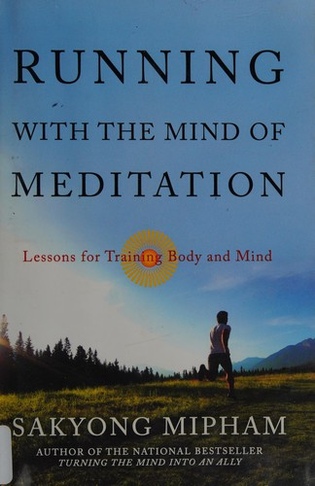
What the book covers
Sakyong Mipham, head of Shambhala (an international network of meditation centers) and a dedicated marathon runner himself, brings a unique perspective to the intersection of physical discipline and mental practice. Running with the Mind of Meditation isn't quite a running manual and isn't quite a meditation guide: it's something more elegant: a practical philosophy showing how the two reinforce each other.
The book is organized around the "four dignities" drawn from Shambhala teachings: tiger, lion, garuda (bird and human), and dragon. These aren't metaphorical fluff. They represent distinct qualities of progress: the fierce determination to begin, the confident strength to sustain, the expansive vision to soar, and the grounded wisdom to finish well. Each phase applies equally to building a running practice and developing a contemplative mind.
Mipham starts with the foundations: why run, why meditate, and how they're fundamentally the same act of showing up to your own life. He walks readers through basic meditation instruction (breath awareness, body scanning) and running progressions. The chapters address motivation, gentleness, managing pain, intention, and, crucially, the relationship between a controlled mind and bodily performance. His central insight is disarmingly simple: a runner who controls their mind is a better runner. Not through willpower alone, but through clarity and presence.
Who should read this
This book works best for two groups. First, people already committed to running who are curious about meditation: those wondering if there's more to the practice than cardio output. Second, meditators who want a structured, athletic context to deepen their practice. If you're the type who runs to think, or sits to prepare yourself for action, Sakyong speaks your language.
If you're looking for a detailed training plan or periodization strategy, look elsewhere. If you're seeking to understand the mechanics of VO2 max or interval training, this isn't it. But if you suspect that your mind is the real frontier in your running, that the mental game matters as much as the physical one, this book opens a credible door.
It's worth noting upfront: Sakyong Mipham has faced documented allegations of sexual misconduct. Multiple women accused him of inappropriate sexual advances and abuse of power within his organization. While he issued an apology in 2018 and stepped back from his formal leadership role, these allegations are part of the record. This doesn't automatically disqualify the book's ideas, but it's information readers deserve to consider when deciding whether to invest time and trust in an author's voice.
Strengths and weaknesses
Strengths:
The book's greatest strength is its refusal to treat running and meditation as separate domains. Modern wellness culture tends to compartmentalize: you meditate to de-stress, you run to stay fit. Sakyong argues convincingly that these practices inform each other. A runner who learns to watch their breath without judgment develops resilience. A meditator who trains aerobically anchors abstract insights in the body. That integration is valuable.
The writing is clear and grounded. Sakyong doesn't hide behind mysticism or yoga-speak. He talks honestly about pace, effort, pain management, and mental fatigue. The book feels like advice from someone who has actually logged miles and hours of meditation, not theory from an armchair.
The format works. At 208 pages with short chapters, you can read it in a weekend or carry it with you for dips and returns. The ideas are digestible and memorable: the kind that stay with you on a long run.
The book has endured remarkably well since publication in 2012. It maintains a 3.85-star rating across 3,288 Goodreads reviews, which suggests broad, sustained appeal. Readers in 2024 and 2025 still find value in it.
Weaknesses:
The book's reliance on Shambhala terminology and philosophy can feel inaccessible. If you don't resonate with Buddhist cosmology or the language of "enlightened society," some passages will feel abstract or decorative. The four dignities framework is clever, but it's not essential to the core message: readers who skip those sections miss nothing practical.
On the science side, Sakyong is thin. If you want research on how mindfulness improves running economy, or what neuroimaging shows about meditation's effect on pain perception, this book won't deliver. It's philosophy and instruction, not evidence-based analysis. That's fine for what the book intends to be, but it's a real limitation if you're looking for the science behind the integration.
Some readers reported fatigue with the writing toward the latter chapters, noting the book felt tedious by the end. This suggests the material doesn't sustain as powerfully as it opens.
The meditation instruction is basic: genuinely useful for beginners, but very shallow if you already have a practice. The running advice, similarly, assumes you know how to run; it focuses on the mental dimension rather than technique.
Mental health and running: The real payload
Here's why this book matters in the context of exercise and mental health: the evidence for running's psychological benefits is now robust. Regular aerobic exercise reduces depression and anxiety as effectively as some medications, increases serotonin and neurotransmitter production, builds emotional resilience, and creates what researchers call a "flow state": the sense of being completely present and engaged. Running also triggers a kind of moving meditation: the rhythm, the breath, the sensory input all conspire to quiet the discursive mind.
But most runners never systematically leverage this. They run for fitness or time, not for mental cultivation. Sakyong's insight (that you can run mindfully, deliberately, with the same awareness you'd bring to sitting meditation) is not new in academia. But it's almost never applied in practice by recreational runners. This book is a rare bridge. It tells you how to do it, and why it matters.
When you practice this integration, running becomes a tool for developing mental clarity and equanimity. You learn to observe your habitual patterns: the urge to push when tired, the tendency to give up, the stories you tell yourself. You practice working with pain without fleeing it. You build what Buddhists call "courage" and psychologists might call "distress tolerance." These skills transfer to everything else.
Final verdict
Running with the Mind of Meditation is a genuinely useful book that asks serious questions and offers real practical answers. It's not perfect: it's spiritually flavored in a way that won't appeal to everyone, it lacks scientific depth, and it's more philosophical than technical. But for readers who want permission to take the mental side of running seriously, and a framework to structure that work, it delivers.
The book sits at an interesting cultural moment. In 2012, bridging running and meditation was countercultural. In 2026, mindfulness and wellness culture have made the idea more familiar. But that familiarity has also diluted it: most contemporary "mindful running" advice is shallow. Sakyong goes deeper. He asks you to actually meditate, not just "run with intention." He honors running as a genuine practice, not a vehicle for something else.
If you're a runner curious about meditation, or a meditator ready to bring that discipline into your body, read this. If you're looking for a training plan or VO2 max optimization, skip it. If you're interested in the real, growing research on how exercise transforms mental health, this book won't teach you the science, but it will show you how to practice it.
Score: 3.5 out of 5.0
The 3.5 reflects strong strengths (integration, clarity, durability) tempered by real limitations (spiritual framing, lack of depth, inaccessibility to non-Buddhist readers). It's a solid, valuable book for its intended audience, which is substantial, but it's not transcendent.
Sources and further reading
- Running with the Mind of Meditation on Penguin Random House
- Book page on Goodreads (3.85 stars, 3,288 ratings)
- Review from Spirituality & Practice
- Review from Bruce Pegg
- Trail and Ultra Running book review
- Sakyong Mipham's allegations of sexual misconduct - CBC News
- Pema Chodron retires as Shambhala teacher - Washington Post
- Mindful Running: The Ultimate Guide to Meditative Running
- The Power of Running and Meditation - Mindful Magazine