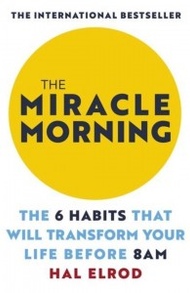
Some books arrive with a story so good you almost forgive the marketing. Hal Elrod's begins with a car crash at twenty: hit head-on by a drunk driver, dead for six minutes, eleven broken bones, told he might never walk again. He walked. Then he ran an ultramarathon. Then, years later, broke and depressed after the 2008 crash, he stumbled onto the routine that became The Miracle Morning - a book that started as a self-published underdog in 2012 and has since sold millions of copies and spawned an entire franchise of spin-offs. If you have ever scrolled past someone online evangelising their 5 a.m. routine, this is almost certainly the seed it grew from.
What the book covers
The premise is refreshingly small. Elrod argues that how you spend the first hour of your day quietly sets the tone for everything that follows, and that most of us surrender that hour to the snooze button and a scramble. His fix is a stackable ritual he brands S.A.V.E.R.S.: Silence (meditation or quiet prayer), Affirmations, Visualization, Exercise, Reading, and Scribing, which is just a slightly grander word for journaling. You move through all six each morning, and the genius of the format is that it scales. Got an hour? Spend ten minutes on each. Got six minutes? Spend one minute on each. The point is consistency, not duration.
Around that core, Elrod builds the case for why mornings matter, why most people resist them, and how to actually drag yourself out of bed when every instinct says stay put. His "five-minute snooze-proof wake-up strategy" is the kind of practical, slightly silly advice that genuinely works: move the alarm across the room, set positive intentions the night before, drink a glass of water, brush your teeth, and so on. None of it is revolutionary, and Elrod cheerfully admits as much. The not-so-obvious secret of the subtitle is really just the discipline of doing simple things, on purpose, before the world wakes up.
Who should read this
This is a starter book, and I mean that as a compliment. If you have never had a morning routine, never kept a journal, and feel a bit lost about where personal-development habits even begin, The Miracle Morning hands you a ready-made template you can follow tomorrow without buying anything else. It is especially good for people who find the wider self-help shelf intimidating - Elrod writes like an enthusiastic friend, not a guru handing down commandments, and the low barrier to entry is the whole appeal.
It is a weaker fit if you are already a seasoned reader of this genre. If you have worked through Atomic Habits or kept a journaling practice for years, much of this will feel like familiar ground dressed in new branding. You will likely nod along, extract the S.A.V.E.R.S. acronym, and feel you could have skipped the surrounding two hundred pages. That is not a failing of the idea so much as a sign you have outgrown the introduction.
Strengths and weaknesses
Let me be honest, because this book divides people sharply and a fair review should reflect that. On Goodreads it sits at a respectable 3.9 from tens of thousands of ratings, and its fans are passionate - people who credit it with genuinely turning their lives around. The strengths are real: the framework is simple, flexible, and actionable, the tone is warm and motivating, and the underlying habits (meditation, movement, reading, reflection) are well supported by everything we know about wellbeing. Stack them into one morning and you are doing yourself a real favour.
The criticism is equally real, and it is why I have landed on three and a half stars rather than higher. The book is repetitive. The central concept is simple enough to explain in a long article, and Elrod stretches it with anecdotes, recaps, and a steady drumbeat of testimonials from people whose lives the method transformed. After a while the parade of glowing quotes starts to feel like a sales pitch rather than evidence, and there is a fair bit of pointing you toward his website, his journal, and his other products. If you bristle at self-promotional spin layered over old ideas, you will feel that friction here. The substance is sound; the packaging is louder than it needs to be.
Why this matters for mental health
Strip away the branding and the heart of S.A.V.E.R.S. is a quietly therapeutic practice. The Scribing step is structured morning journaling, and the Affirmations step is a daily exercise in reframing how you talk to yourself - both of which overlap meaningfully with tools used to ease anxiety and build self-efficacy. Starting the day by writing down what you are grateful for, what you intend, and how you want to feel can interrupt the anxious autopilot many of us wake into, and a small, controllable ritual gives the nervous system something steadying to hold onto. It is not therapy, and Elrod never claims clinical authority, but as a gentle entry point into reflective writing and intentional self-talk, the routine does real psychological work.
Final verdict
The Miracle Morning is not a perfect book, and I would never pretend otherwise - it is padded, repetitive, and a touch too keen to sell you the next thing. But the idea at its centre is good, the price is low, and the barrier to actually trying it is almost nonexistent. For the cost of a couple of coffees you get a framework you can put into practice the very next morning, and if even half of it sticks, you come out ahead. If you have been meaning to build a morning routine or finally start a journaling habit and just need someone to hand you a simple plan and a bit of encouragement, this is a worthwhile, low-risk place to begin. Read it for the structure, take what serves you, and quietly skip the sales pitch. Your 6 a.m. self might just thank you.