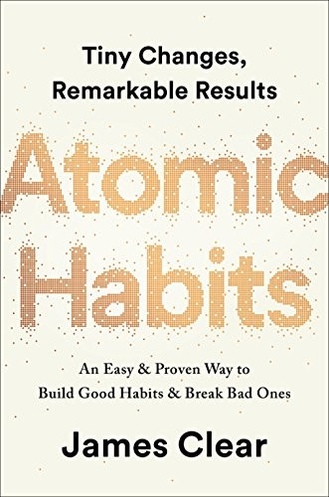
Atomic Habits is the book everyone has already read and still keeps recommending. Published in 2018 by James Clear, a writer who spent years publishing twice-weekly essays on habit formation before putting a book together, it has sold close to twenty million copies and spent more than two hundred weeks on the New York Times bestseller list. Those are the kind of numbers that usually belong to books that promise a lot and deliver little. This one is different - the reason it keeps working is that the advice is, for the most part, correct.
What the book covers
Clear opens with an argument that is simple enough to sound trite and subtle enough to genuinely change how you approach self-improvement: you do not need a dramatic overhaul, you need a one percent improvement, repeated. Small changes compound. A habit that seems trivial today - writing three sentences in a journal, stretching for two minutes, closing the laptop at 10pm - becomes load-bearing over a year. Most people overestimate what they can do in a month and wildly underestimate what they can do in a decade.
From there he builds the book around a four-part framework: make it obvious, make it attractive, make it easy, make it satisfying. Each of these unpacks into a set of practical tactics - habit stacking, environment design, implementation intentions, the two-minute rule, habit tracking, variable rewards. Clear walks through each with the same structure: principle first, then a story, then a concrete tactic you can use tonight. It reads less like a self-help book and more like a well-organised field manual.
The book's most durable contribution, though, is the distinction between outcome-based and identity-based habits. Most people try to change what they do. Clear argues you should instead focus on who you are becoming - the goal is not to run a marathon, it is to become a runner. Every time you go for a short run, even a bad one, you cast a vote for that identity. Over time, the identity becomes self-reinforcing. This reframe is deceptively powerful. It is the thing most readers end up quoting years after they have forgotten the Four Laws.
Who should read this
This is for the person who keeps setting the same New Year's resolution and abandoning it by February. It is for the anxious overachiever who wants to build a meditation practice but cannot make it stick. It is for the parent trying to model better behaviour for a child, the recovering perfectionist who needs permission to start small, and anyone who has used the phrase "I just need more discipline" in the last six months. Clear's framing is kinder than most habit advice - he treats failure to change as an engineering problem, not a character flaw, and that alone makes the book worth reading.
It is not a mental health book in the clinical sense. If you are dealing with clinical depression or anxiety, Atomic Habits is not a substitute for treatment. But it pairs beautifully with therapy. A lot of CBT homework boils down to building new behavioural patterns, and Clear gives you the mechanics for doing exactly that.
Strengths and weaknesses
The strength of Atomic Habits is its usability. Every chapter delivers something concrete, and the structure is relentlessly practical. Clear writes with unusual economy - the sentences are short, the examples are specific, and nothing is padded. If you read one chapter a night and apply one idea per week, you will be noticeably different by summer. Few books of this genre can make that claim honestly.
The weaknesses are real but modest. Clear sometimes overstates the certainty of the behavioural science he draws on - a few of the studies he references are smaller or more contested than the confident tone suggests. The book is also relentlessly individualistic. It treats habit formation as a problem of personal systems and rarely engages with the structural or social factors that make habits harder for people in difficult circumstances. For a reader with a chaotic schedule, unstable housing, or a demanding caregiving role, some of the advice will feel out of reach.
A 4.5 feels fair. The core framework is robust, the writing is a cut above almost everything else in the category, and the identity-based framing is the kind of idea that genuinely changes behaviour. The overconfidence on a handful of studies is worth flagging but does not undermine the book.
Why this matters for mental health
Habits and mental health are tangled in ways most people underestimate. Anxiety feeds on inconsistency, depression feeds on inertia, and both respond to the quiet dignity of a small daily practice you can actually keep. Clear never frames Atomic Habits as a mental health book, but the mechanics he describes - stacking a new behaviour onto an existing cue, making the good thing easier and the bad thing harder, building identity through evidence - are precisely the tools a good therapist will hand you in session. For the Mind Wobble reader, this is foundational. The work of getting better is mostly the work of showing up in small ways, repeatedly. This book shows you how.
Final verdict
Atomic Habits has earned its ubiquity. It is short enough to finish in a weekend, practical enough to start using on a Monday, and kind enough to the reader that you do not come away feeling lectured. A few of the confident claims deserve a pinch of salt, and the individualistic framing has limits, but the core of the book is sound and the tactics genuinely work. If you have been meaning to change something about how you live and keep stalling at the start line, this is the book that gets you moving.